Walking vs. Jogging for New Exercisers
26 November 2026
You have decided to start exercising. That decision matters more than the specific activity you pick, but the choice between walking and jogging will shape your first few months in ways you might not expect. Both are accessible. Both require almost no equipment. Both can be done from your front door. Yet they place very different demands on your body, your schedule, and your motivation.
This comparison is not about which activity is "better." It is about which one fits your current body, your current life, and your current psychology, and how to use that knowledge to build a routine you will still be following six months from now.

Why This Choice Matters More Than You Think
New exercisers often treat walking and jogging as interchangeable entry points. They are not. Walking is a low-impact activity that most people can sustain for thirty to sixty minutes with minimal preparation. Jogging is a high-impact activity that loads your joints with multiples of your body weight with every stride.That difference in impact changes everything downstream: injury risk, recovery time, how often you can train, how quickly you see fitness gains, and how your body feels the next morning. Choosing the wrong entry point does not just slow your progress. It can end your routine before it becomes a habit.
There is also a psychological dimension. Jogging feels like "real exercise" to many people, while walking can feel too easy to count. That perception pushes some beginners into jogging too soon, and it causes others to dismiss walking as insufficient. Both reactions cost people results.

What Walking Actually Does for a Beginner
Walking is a rhythmic, low-impact movement that raises your heart rate modestly and keeps it there. For a sedentary person, that modest elevation is often enough to produce meaningful cardiovascular adaptation in the first weeks and months.The physiology of a brisk walk
When you walk briskly, your heart rate typically rises into a moderate zone, roughly 50 to 70 percent of your estimated maximum. At this intensity, your body relies mostly on fat and a mix of fuels, your blood pressure stays relatively stable, and your joints absorb forces close to your body weight rather than multiples of it. Your muscles work continuously but without the explosive loading that running produces.This is why walking is so forgiving. You can walk daily without accumulating significant fatigue. You can walk with sore knees, with extra body weight, after a long workday, and in ordinary shoes. The barrier to entry is almost zero, and the recovery cost is minimal.
Where walking shines
Walking is the better starting point in several specific situations:- You have been inactive for a long period, and your joints, tendons, and muscles are not adapted to impact.
- You carry significant extra body weight, which amplifies joint loading during running.
- You have a history of knee, hip, or lower back issues.
- You are returning from injury or illness.
- You want to build consistency before intensity, which is the more durable path for most beginners.
Walking also fits more easily into a busy day. A twenty-minute walk after lunch requires no changing, no shower, and no recovery. That low friction matters enormously when you are trying to establish a habit.
The limits of walking
Walking has a ceiling. Once your cardiovascular fitness improves, a brisk walk may no longer elevate your heart rate enough to drive further adaptation. At that point, you need to either walk faster, walk uphill, walk longer, or add a more intense activity. This is not a flaw. It is simply the nature of a low-intensity activity. Walking is an excellent foundation, but most people eventually need to add intensity somewhere.
What Jogging Actually Does for a Beginner
Jogging is a higher-intensity, higher-impact activity. Even a slow jog elevates your heart rate more than a brisk walk and recruits your muscles with greater force. It also imposes impact forces on your legs and joints that walking does not.The physiology of a jog
During a jog, your heart rate typically climbs into a moderate to vigorous zone, often 60 to 80 percent of maximum or higher depending on pace. Your body begins to rely more on carbohydrates for fuel, your breathing becomes noticeably deeper, and your muscles experience repeated stretch-shortening cycles with each stride. Ground reaction forces during running can reach two to three times your body weight, compared with roughly one to one and a half times during walking.That impact is not inherently bad. Load is how tissue adapts and grows stronger. But load must be introduced gradually. Tendons, bones, and cartilage adapt more slowly than your heart and lungs do. This mismatch is the single biggest reason new joggers get hurt: their cardiovascular system handles the effort long before their connective tissue does.
Where jogging shines
Jogging is the better choice when:- You already have a base of activity and your joints tolerate impact well.
- You want to improve cardiovascular fitness efficiently with limited time.
- You enjoy the feeling of running and find walking unsatisfying.
- You want to build bone density, since impact loading stimulates bone adaptation more than walking does.
- You have a specific goal that requires running, such as a future race or a sport.
Jogging also delivers more fitness per minute. A thirty-minute jog generally produces a greater cardiovascular stimulus than a thirty-minute walk. If time is your scarcest resource, that efficiency matters.
The limits of jogging
Jogging punishes poor progression. Beginners who jump from no activity to thirty minutes of continuous jogging often develop shin splints, knee pain, or Achilles irritation within weeks. The activity also demands more recovery, which means you cannot necessarily jog every day at first. And it requires more attention to footwear, running surface, and technique than walking does.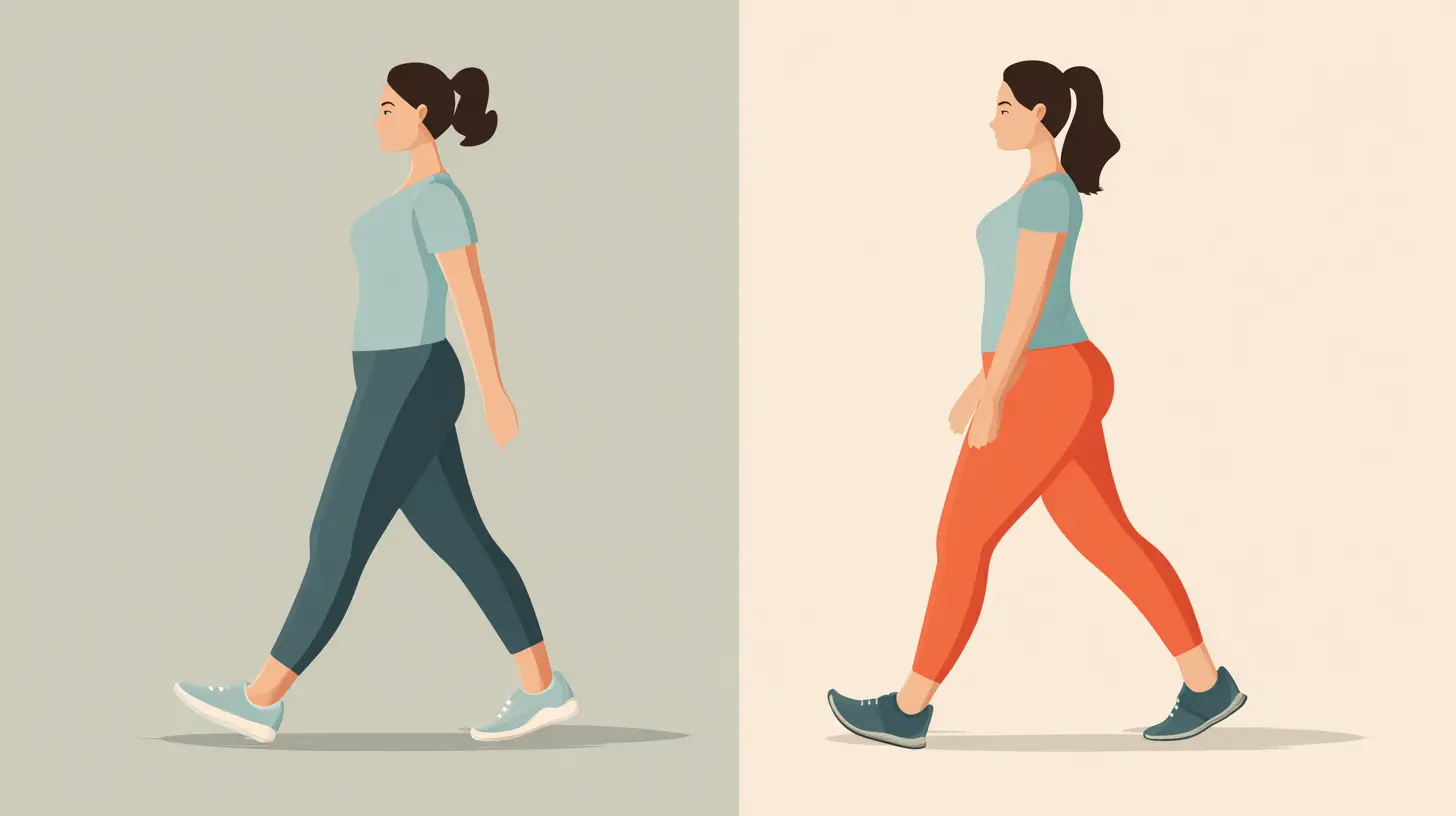
The Impact Question: Why It Decides So Much
If you take one idea from this article, make it this: the difference between walking and jogging is not primarily about effort. It is about impact, and impact tolerance is the variable that should drive your decision.Think of your connective tissue as a slow adapter. Your heart and lungs respond to training within weeks. Your tendons, bones, and cartilage respond over months. When you jog, you are asking your slow adapters to keep up with your fast ones. If you progress faster than your tissues can remodel, you get pain.
Walking sidesteps this problem because its impact forces are close to what your body already handles in daily life. That is why a sedentary person can often walk thirty minutes on day one without consequence, while the same person jogging thirty minutes on day one is taking a real risk.
This does not mean jogging is dangerous. It means jogging requires a ramp. The standard advice among running coaches is to increase weekly running volume gradually, often cited as no more than about ten percent per week, and to alternate running and walking in the early weeks. That approach respects the adaptation timeline of connective tissue.
A Practical Hybrid: The Run-Walk Method
The binary framing of walking versus jogging hides the most useful option for beginners: combining them. Run-walk intervals let you capture much of jogging's cardiovascular benefit while keeping impact and fatigue manageable.A simple starting structure might look like this: five minutes of brisk walking to warm up, then alternating one minute of easy jogging with two minutes of walking for twenty to thirty minutes, then five minutes of walking to cool down. Over weeks, you can lengthen the jogging intervals and shorten the walking ones.
Why does this work so well? Because it limits the total impact dose per session while still exposing your tissues to running loads. Your tendons and bones get a manageable stimulus, your heart rate rises meaningfully, and you finish feeling capable rather than wrecked. The walk breaks are not a sign of weakness. They are a progression tool.
Many beginner running programs are built on exactly this principle. If you are unsure whether you are ready to jog continuously, you probably are not, and run-walk intervals are the honest middle path.
Comparing the Two Across Key Dimensions
Cardiovascular fitness
Jogging produces a larger cardiovascular stimulus per minute. Walking produces a smaller one but can be sustained longer and more frequently. Over a week, a person who walks briskly for forty-five minutes daily may accumulate a comparable or greater total volume of moderate activity than someone who jogs twenty minutes three times a week. The best choice depends on how much time you have and how often you can train.Calorie expenditure
Jogging burns more calories per minute than walking, largely because of the greater energy cost of running and the higher intensity. However, walking for a longer duration can narrow the gap. The more important point for beginners is that neither activity alone will drive significant weight loss without attention to overall energy intake. Exercise contributes to energy expenditure, but it is rarely the dominant lever for weight change.Joint and tissue health
Walking is gentler on joints and connective tissue. Jogging loads them more but, when progressed sensibly, can strengthen bone and tendon. The key word is sensibly. Impact is a tool, not a hazard, provided the dose is appropriate.Injury risk
New joggers face a meaningfully higher injury risk than new walkers, primarily from doing too much too soon. Walking injuries are uncommon and usually minor. This difference alone justifies starting with walking if you are uncertain about your tolerance.Time efficiency
Jogging wins on time efficiency. A thirty-minute jog delivers more fitness stimulus than a thirty-minute walk. If your schedule is tight and your body tolerates impact, jogging or run-walking is the more efficient use of that window.Psychological sustainability
This one is personal. Some people find walking boring and need the challenge of jogging to stay engaged. Others find jogging intimidating or unpleasant and will stick with walking far longer. The activity you actually do beats the activity that is theoretically superior. Be honest with yourself about which one you will repeat next week.Accessibility and cost
Both are cheap. Walking requires only supportive shoes. Jogging benefits from proper running shoes, which cost more, and from attention to running surface. Walking can be done in almost any clothing and location. Jogging is less forgiving of poor footwear and hard surfaces.Common Mistakes Beginners Make
Starting with jogging because walking feels too easy. Easy is the point in the early weeks. Walking builds a base and teaches your body to move regularly. Skipping that step often leads to injury and a restart from zero.Progressing too fast once jogging feels good. The first two weeks of jogging often feel surprisingly easy because your cardiovascular system adapts quickly. The pain tends to arrive in weeks three to six, when cumulative impact catches up with under-prepared tissue. Resist the urge to add distance or frequency aggressively.
Ignoring shoes. Walking tolerates ordinary shoes reasonably well. Jogging does not. Worn-out or improper footwear concentrates impact and contributes to shin, knee, and foot problems. If you jog, get fitted for running shoes at a specialty store if possible.
Treating walk breaks as failure. Walk breaks are a training tool, not a concession. They let you accumulate more total running time with less fatigue and lower injury risk.
Skipping the warm-up. Five minutes of easy walking before jogging raises tissue temperature and prepares your body for impact. It is a small habit with an outsized effect on comfort and injury risk.
Doing too much on hard surfaces. Concrete is less forgiving than asphalt, and asphalt is less forgiving than dirt or a synthetic track. Beginners who jog exclusively on sidewalks often notice more shin and knee discomfort. Varying surfaces helps.
Confusing soreness with progress. Muscle soreness after a new activity is normal. Sharp pain, joint pain, or pain that worsens with each session is not. Learn to tell the difference and back off when it is the latter.
Neglecting strength work. Both walking and jogging benefit from basic strength training for the legs, hips, and core. Stronger muscles and tendons tolerate load better and reduce injury risk. Two short sessions per week are enough for most beginners.
Misconceptions Worth Clearing Up
"Walking does not count as exercise." It does. Brisk walking is moderate-intensity activity by standard public health definitions, and it produces real cardiovascular and metabolic benefits, especially for people starting from inactivity."Jogging ruins your knees." Recreational jogging, progressed sensibly, is not associated with increased rates of knee osteoarthritis in most observational research. In fact, some evidence suggests moderate running may support joint health. The problems come from excessive volume, poor progression, and pre-existing issues, not from jogging itself.
"You must jog to lose weight." Weight change is driven primarily by overall energy balance. Walking burns fewer calories per minute but is often easier to sustain daily and does not spike appetite as much as intense exercise can. Many people find walking a more sustainable component of a weight management plan.
"More is always better." Recovery is part of training. Beginners who rest adequately adapt faster than those who push through fatigue. This is especially true with jogging.
"You need to be fit before you start." You get fit by starting, not before. The question is only where to start, and walking is a legitimate starting point for almost anyone.
How to Decide: A Practical Framework
Ask yourself these questions before choosing:1. How active have you been in the past three months? If largely sedentary, start with walking or run-walk intervals.
2. How does your body handle impact? If you have joint pain, prior injuries, or significant extra weight, walking is the safer entry.
3. How much time do you have per session? If thirty minutes is your ceiling and you tolerate impact, jogging or run-walking is more efficient. If you have forty-five to sixty minutes, walking becomes far more viable.
4. What will you actually repeat? Choose the activity you can see yourself doing three to five times per week without dread.
5. Do you have a goal that requires running? If so, plan a gradual run-walk progression rather than jumping straight into continuous jogging.
A reasonable default for most beginners: start with brisk walking for two to four weeks to build consistency and let your tissues adapt to regular activity. Then, if you want more intensity, introduce run-walk intervals and progress gradually. This sequence respects your body's adaptation timeline and reduces the chance of a setback.
Building Your First Eight Weeks
A sample progression might look like this:Weeks one and two: Brisk walking for twenty to thirty minutes, three to four times per week. Focus on consistency, not speed.
Weeks three and four: Extend walks to thirty to forty minutes or add gentle hills. If you feel ready, introduce one session per week of run-walk intervals, such as one minute jogging and two minutes walking, repeated for twenty minutes.
Weeks five and six: Two run-walk sessions per week, gradually lengthening jogging intervals to two or three minutes. Keep the third or fourth session as a plain walk.
Weeks seven and eight: If your body is comfortable, work toward continuous jogging for fifteen to twenty minutes, or continue run-walk intervals indefinitely if they suit you. Add one longer, easy walk each week for volume without impact.
Adjust based on how you feel. If pain appears, drop back a step. Progression is not linear, and backing off is part of the process, not a failure of it.
The Bottom Line
Walking and jogging are not rivals. They sit on a continuum of intensity and impact, and the smart beginner uses that continuum rather than picking a side. Walking is the more forgiving entry point and the better choice for anyone with joint concerns, significant inactivity, or a preference for low-friction routines. Jogging is more time-efficient and delivers a stronger cardiovascular and bone stimulus, but it demands gradual progression and attention to footwear and recovery.The best choice is the one that matches your body's current tolerance and your life's current constraints, and that you will still be doing months from now. Start where you are, progress deliberately, and let consistency do the work that intensity alone cannot.
all images in this post were generated using AI tools
Category:
Fitness For BeginnersAuthor:

Madeline Howard